Case study
Tackling toxicity with
Unity Safe Voice
Tackling toxicity with
Unity Safe Voice
Tackling toxicity with
Unity Safe Voice
Tackling toxicity with Unity Safe Voice
Tackling toxicity with Unity Safe Voice
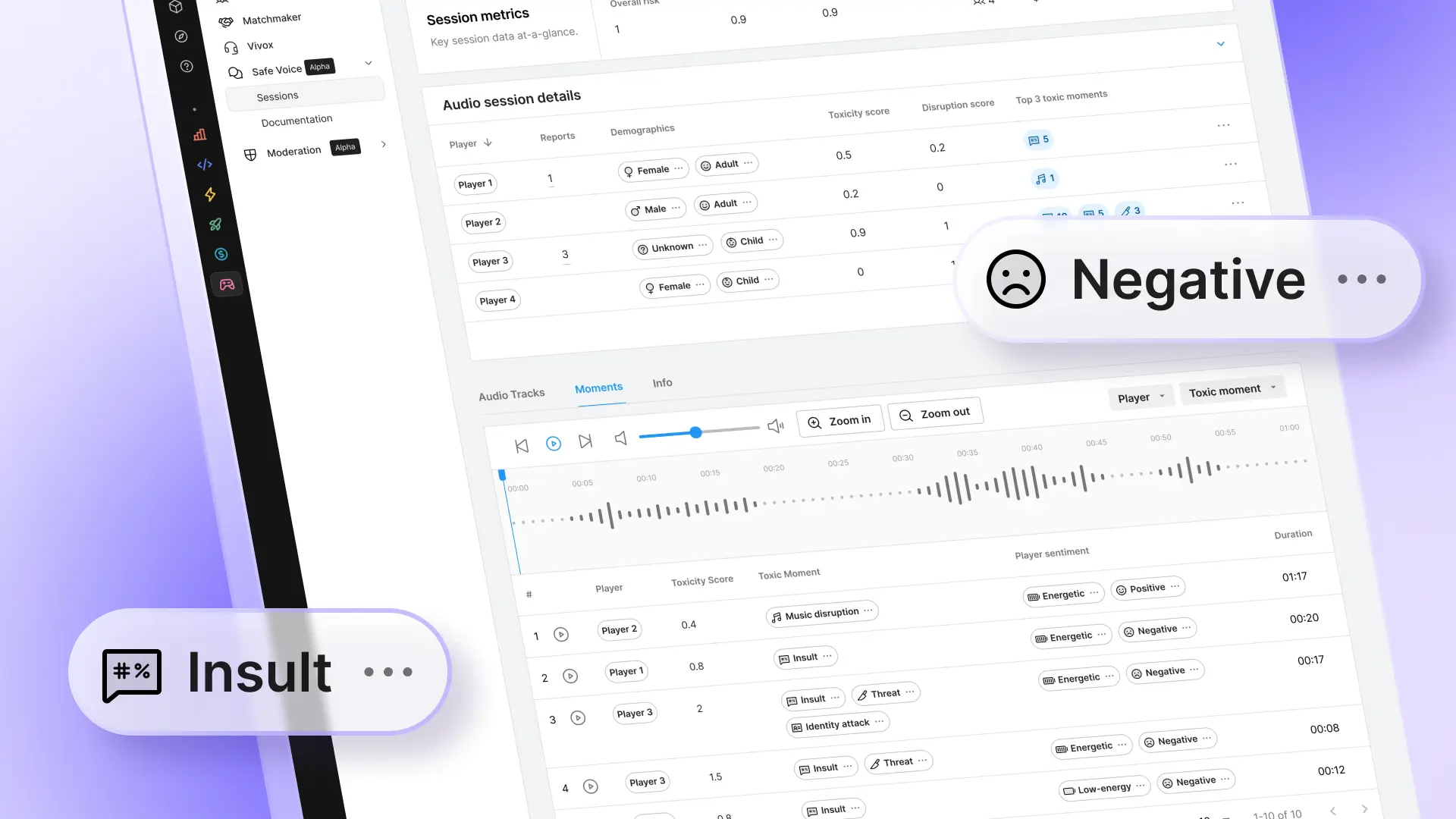
Voice communications in gaming today lack the mechanisms and support to provide safe interactions between players.
Toxicity in multiplayer games is a prevalent issue, with 68% of gamers having experienced it and 43% quitting games because of it. Players overwhelmingly support implementing solutions to address this problem (92%). Unity aims to disrupt this relationship between toxicity and gaming using Safe Voice. Safe Voice is an AI-driven acoustic intelligence platform that Unity acquired in 2021. Initially, it required API integration and lacked visual output for result monitoring, which meant customers had to take extra steps to import files into an external visualization tool.
Company
Unity Technologies
Year
December 2022 - March 2023
My role
As a Product Designer, I was the lead designer on the project conducting user interviews and competitive analysis, designing both the user experience and interface, creating prototypes, preparing and analyzing A/B tests, and overseeing the design QA testing.
Company
Unity Technologies
Year
December 2022 - March 2023
My role
As a Product Designer, I was the lead designer on the project conducting user interviews and competitive analysis, designing both the user experience and interface, creating prototypes, preparing and analyzing A/B tests, and overseeing the design QA testing.
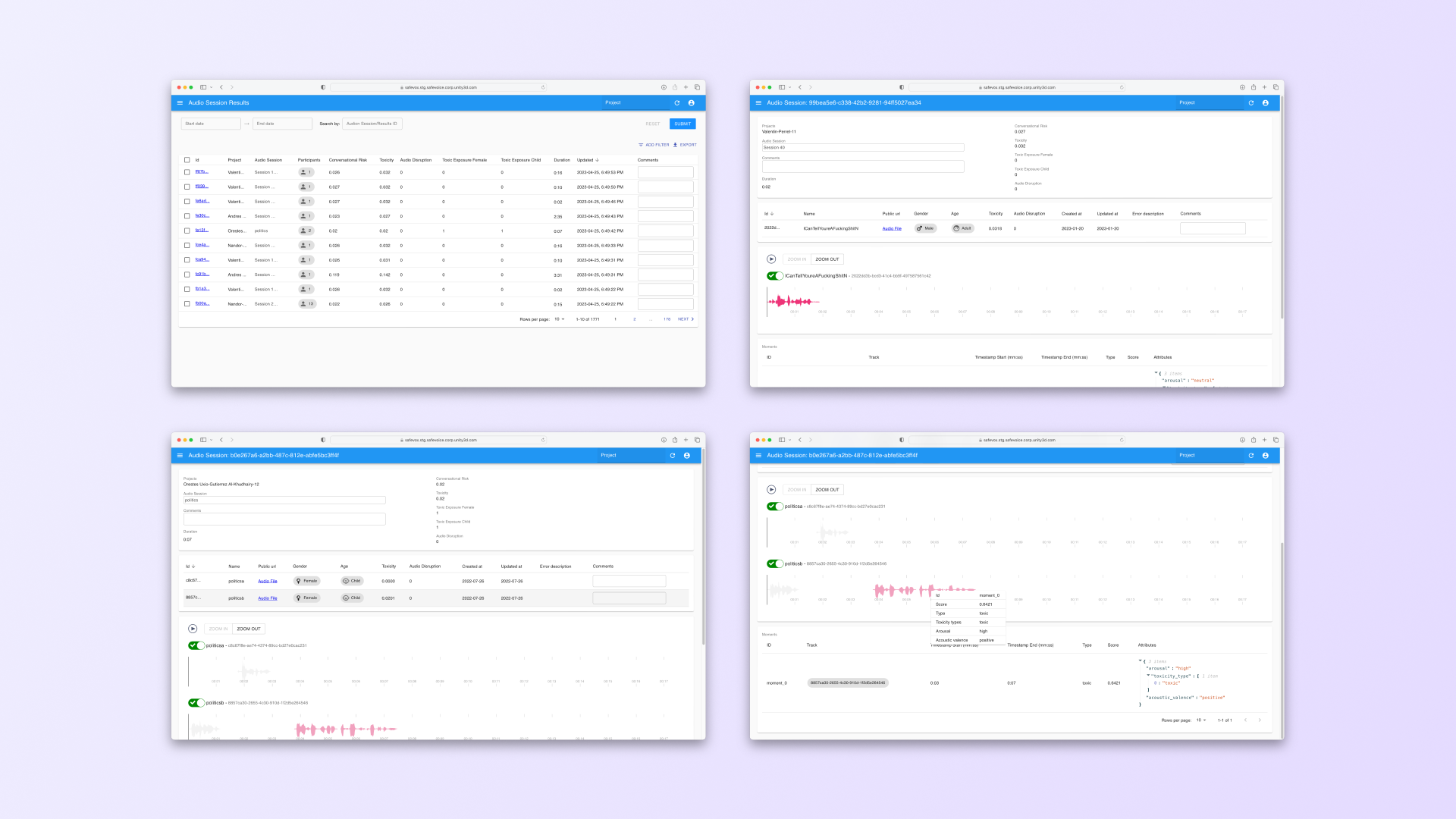
Screens of Safe Voice (OTO) before the aquisition.
Users
Users
The target users for this product were not the usual Unity game developers who use other Unity services. Instead, the focus was on moderators who play a crucial role in gaming communities by overseeing and moderating behavior to combat toxicity. As this group of users was new for Unity, I worked closely with the UX research team to gain a deeper understanding into their needs and experiences.
In essence:
- Unity is primarily targeting Moderators that are employed by game studios, but Moderators can also be volunteers from a game’s community.
- Moderators need to review countless numbers of incoming reports and are therefore constantly exposed to toxicity.
- With the current solutions on the market, game studios struggle to find the most efficient way to collect evidence to help Moderators make the right judgment.

Business Objectives
This initiative aims to simplify the integration process and expedite customer adoption and satisfaction by developing a user-friendly interface, specifically catered to non-technical users. Unity also planned to involve early costumers in the process of training and refining its AI model with real data.
The Solution
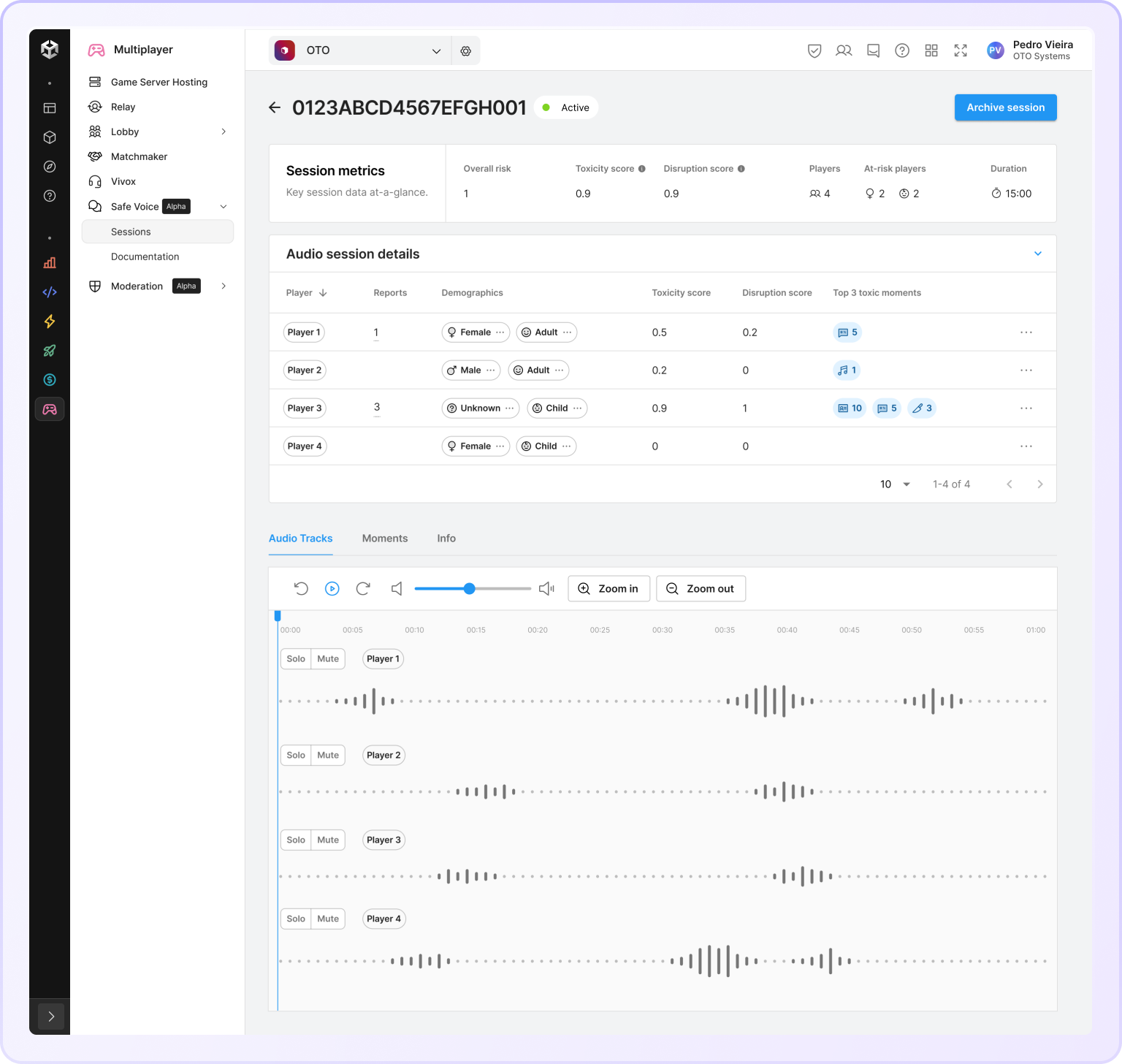
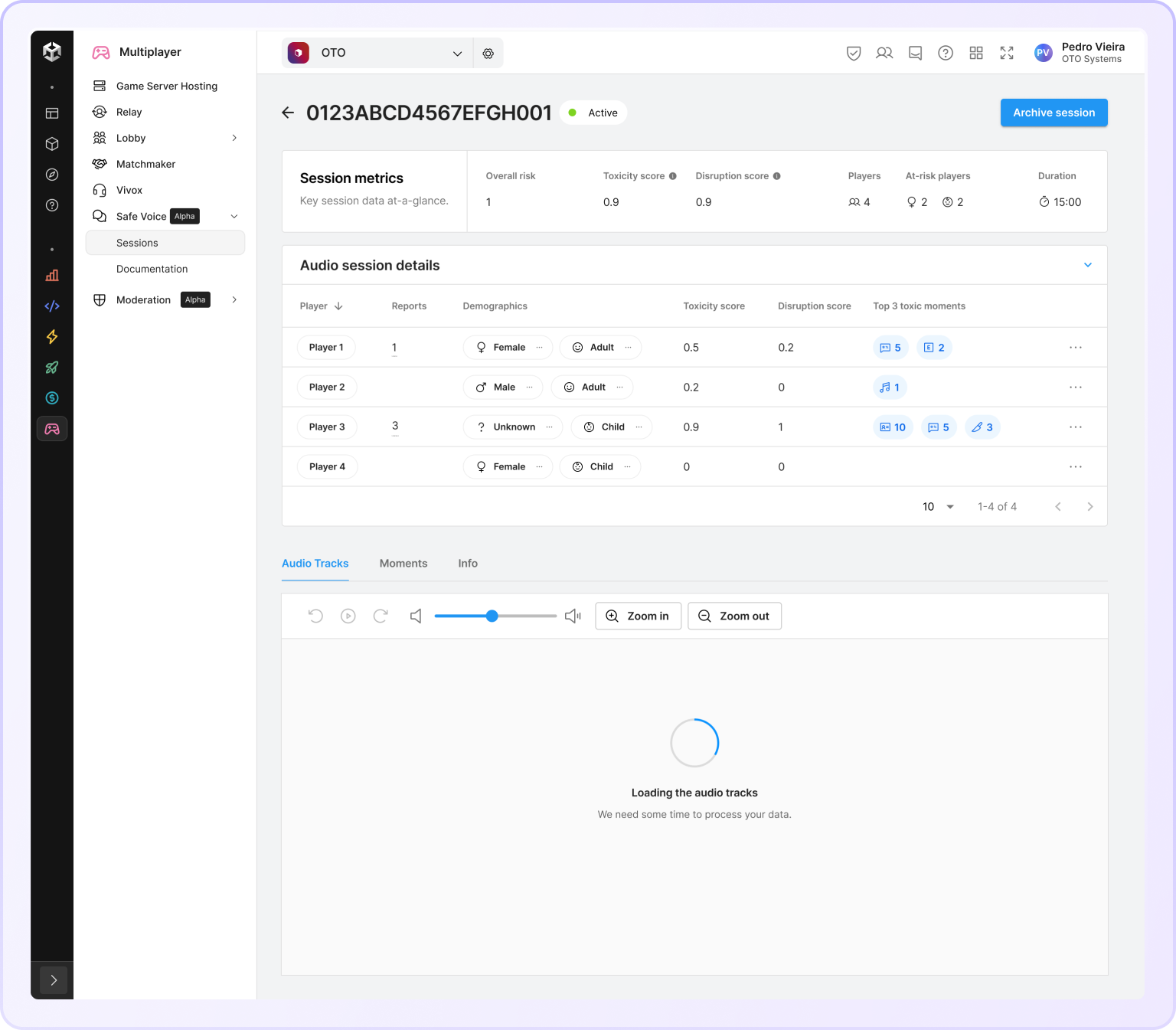
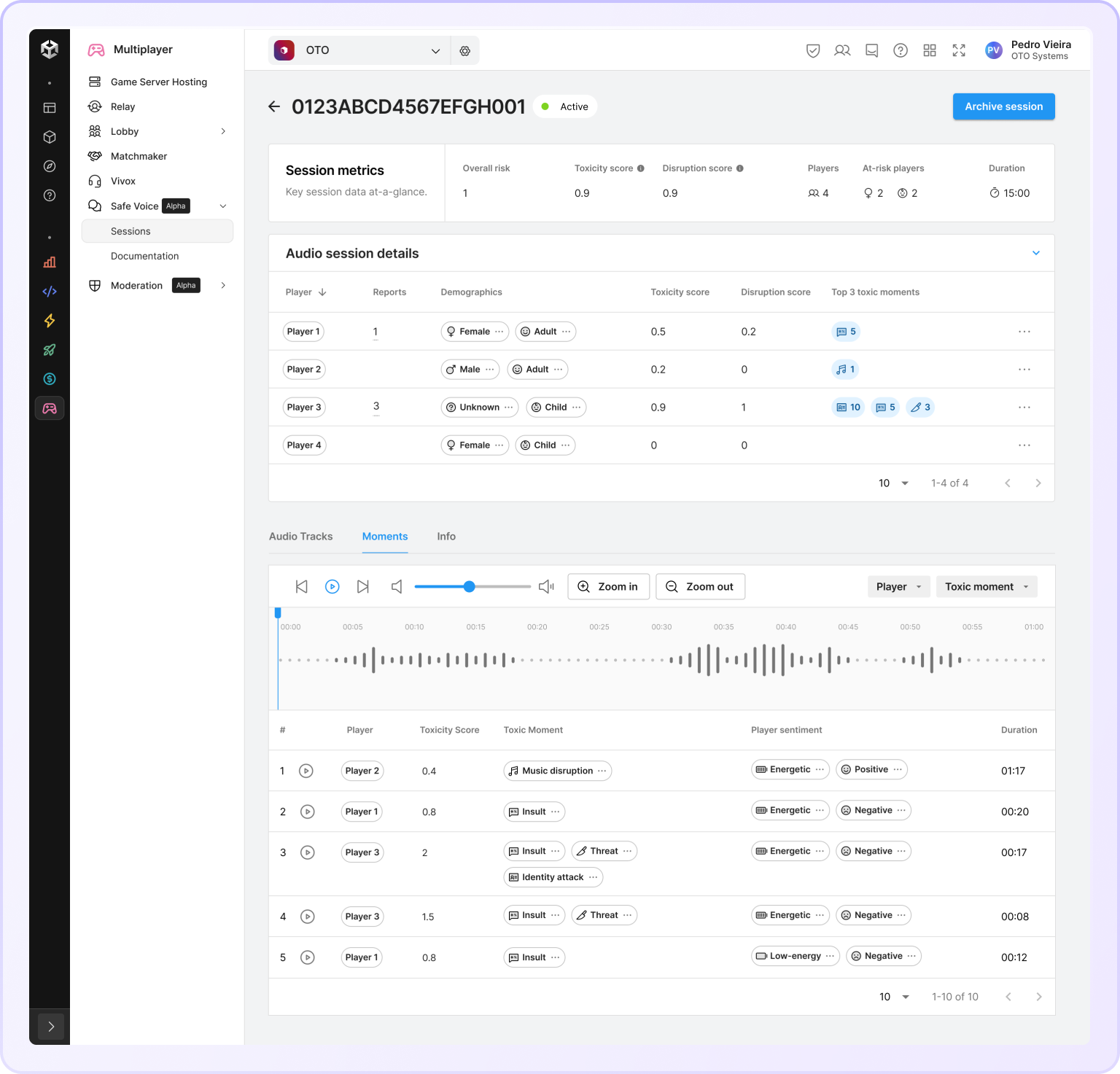
Providing users with a workflow that enables the discovery and playback of audio sessions from players that have been flagged as toxic.
Overview of
the Design Process
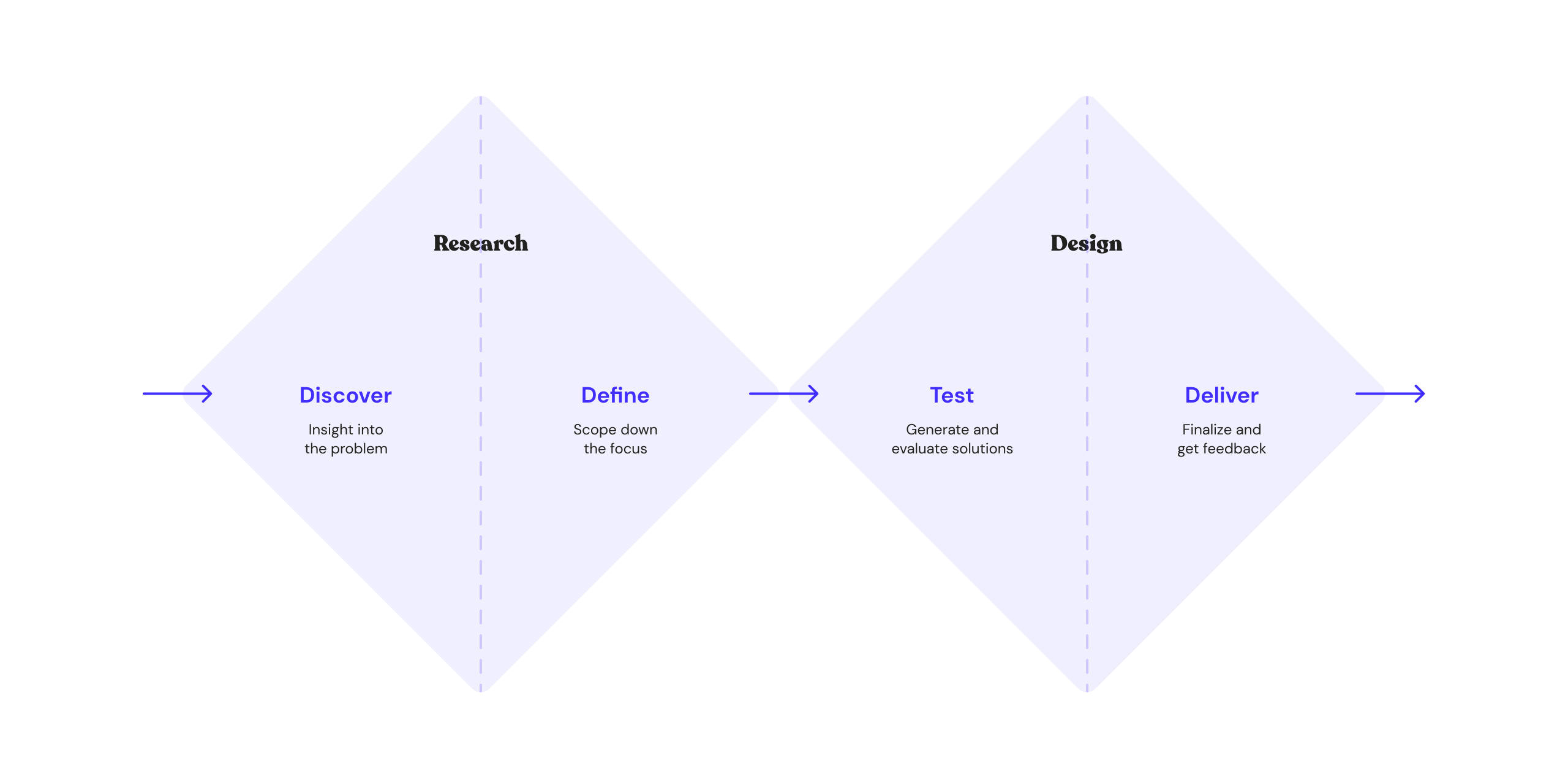
Infographic of the double-diamond design process.
Discovery Phase
Discovery Phase
Discovery Phase
Employing the double diamond design process, I initiated the project by gathering extensive insights through user interviews, conducted with the assistance of a UX researcher. The primary objective was to develop a new User Profile and User Journey, which would serve as the foundation for shaping the product's strategy and vision.
During the process, we began by interviewing Community Managers, but we gradually realized that our targeted user profile needed to be more specific. However, encountering difficulties in recruiting Moderators, we faced a pressing deadline. Despite having collected data from only 2 Moderators, we made the decision to proceed and finalize our user artifacts with input from potential future customers. Thus far, the User Profile we had been working with looked like this:
Employing the double diamond design process, I initiated the project by gathering extensive insights through user interviews, conducted with the assistance of a UX researcher. The primary objective was to develop a new User Profile and User Journey, which would serve as the foundation for shaping the product's strategy and vision.
During the process, we began by interviewing Community Managers, but we gradually realized that our targeted user profile needed to be more specific. However, encountering difficulties in recruiting Moderators, we faced a pressing deadline. Despite having collected data from only 2 Moderators, we made the decision to proceed and finalize our user artifacts with input from potential future customers. Thus far, the User Profile we had been working with looked like this:

Our work-in-progess Moderator User Profile.
To complete my research, I led a collaborative competitive analysis with the engineering team to explore opportunities and understand the current market. I focused on Modulate.Ai and Twitch, specifically examining their user interfaces for reviewing toxic reports and providing feedback to automation tools.
The Opportunity
In summary, Unity has a unique chance to empower moderators by enhancing its Machine Learning capabilities. Moreover, Unity can distinguish itself in the market by providing audio visualization, a feature that sets it apart from competitors.
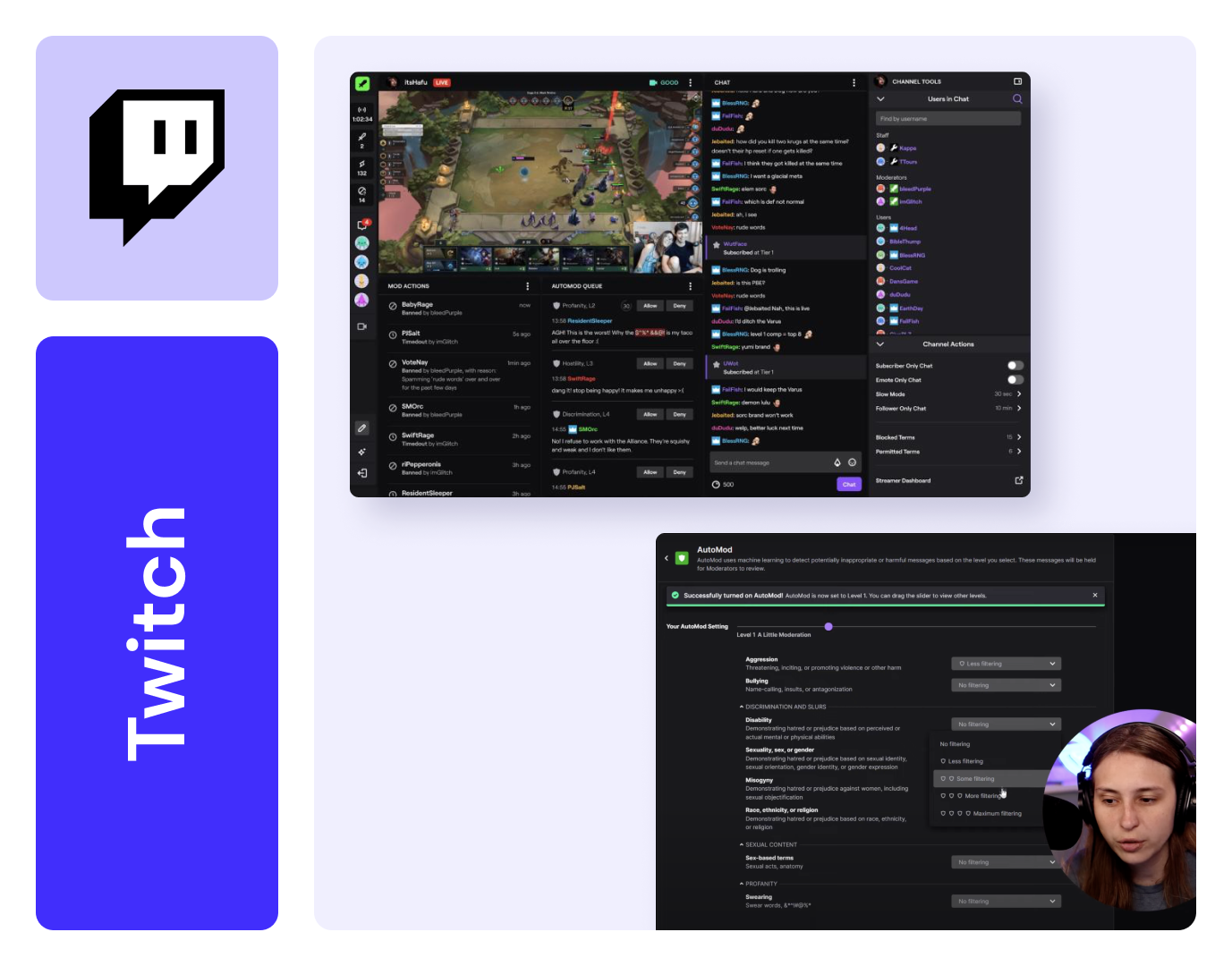

Screenshots from competitors.
Defining the Solution
After interpreting all of our insights from the discovery phase, we aligned user needs and problem into action points to focus our energy on what will bring the most value.
During the Alpha phase, Unity will offer developers processes and tools to record audio sessions as evidence for Moderators to review.
During the Alpha phase, Unity will offer developers processes and tools to record audio sessions as evidence for Moderators to review.
During the Alpha phase, Unity will offer developers processes and tools to record audio sessions as evidence for Moderators to review.
Furthermore, Unity will create visual tools and streamlined workflows to reduce the need for listening to entire audio sessions, leading to improved overall efficiency.
Looking ahead to the Beta phase, Unity will provide data and visualization statistics that enable Moderators to understand the health of their community and observe how toxicity changes over time.
Ideation
At this stage we identified user stories to communicate requirements with stakeholders and the development team to keep the focus on delivering valuable features for users.
- As a Moderator, I need to view and filter all incoming sessions so that I can efficiently manage and prioritize my tasks.
- As a Moderator, I need to review an audio session in detail so that I can comprehensively assess the content and context of the conversation.
- As a Moderator, I need to be able to playback the audio track and provide feedback on inaccuracies so that I can ensure the accuracy and effectiveness of the moderation process.

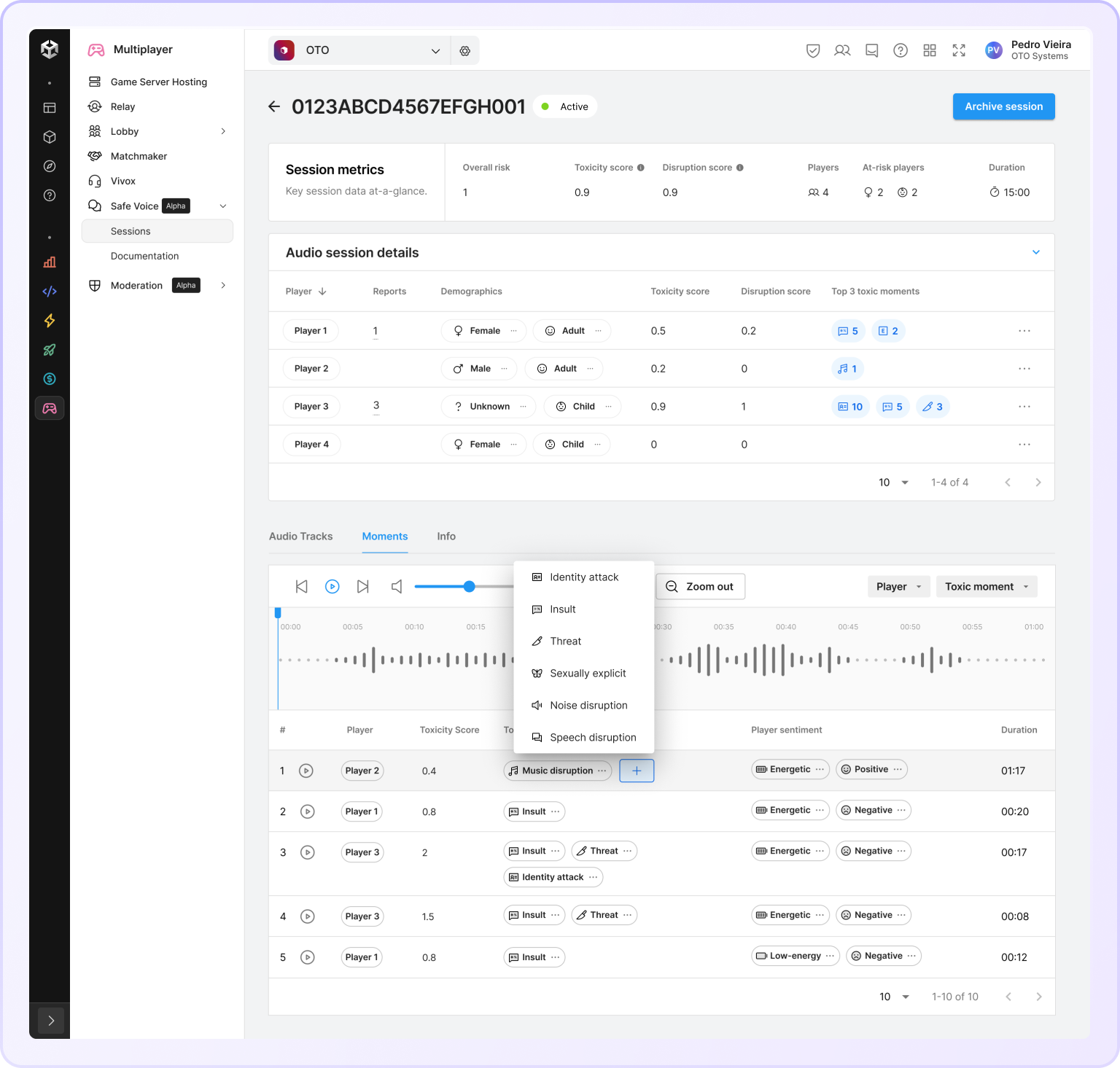
A/B Test
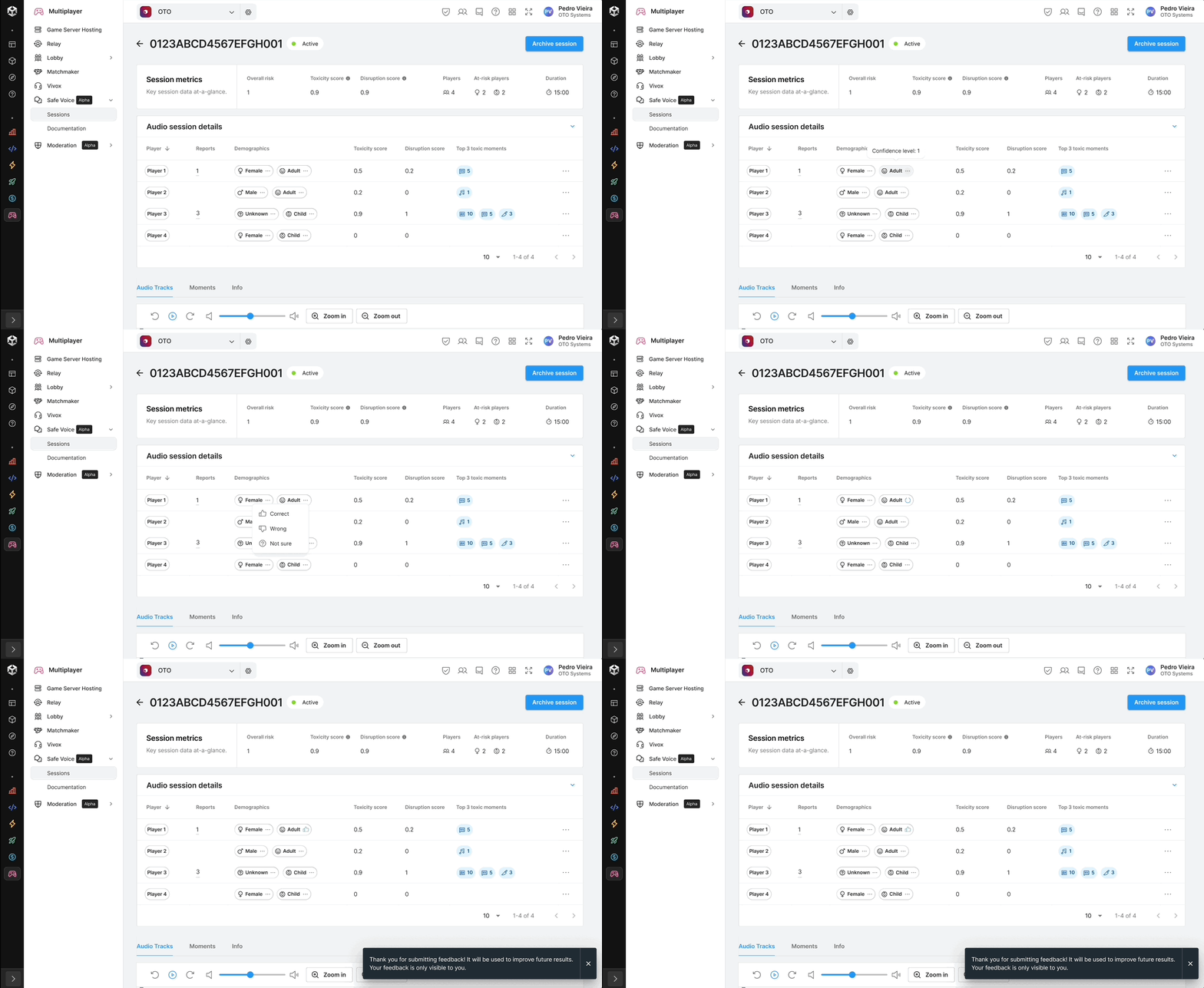
While generating ideas to provide Moderators with tools to refine the Machine Learning, we decided to test 2 solutions to align the team and validate assumptions. To save valuable time, we decided to conduct an internal unmoderated A/B test to better understand which feedback flow to implement with 14 participants, including 3 community managers at Unity.
Key findings:
- Over 70% of users preferred design B. The design was more intuitive and used less clicks than design A.
- The current design layout didn’t meet users expectations. Users expected to view audio tracks as the first thing they would see when landing on the page.
- Users were experiencing issues with the Figma prototype, such as the clicking area and some time delay.
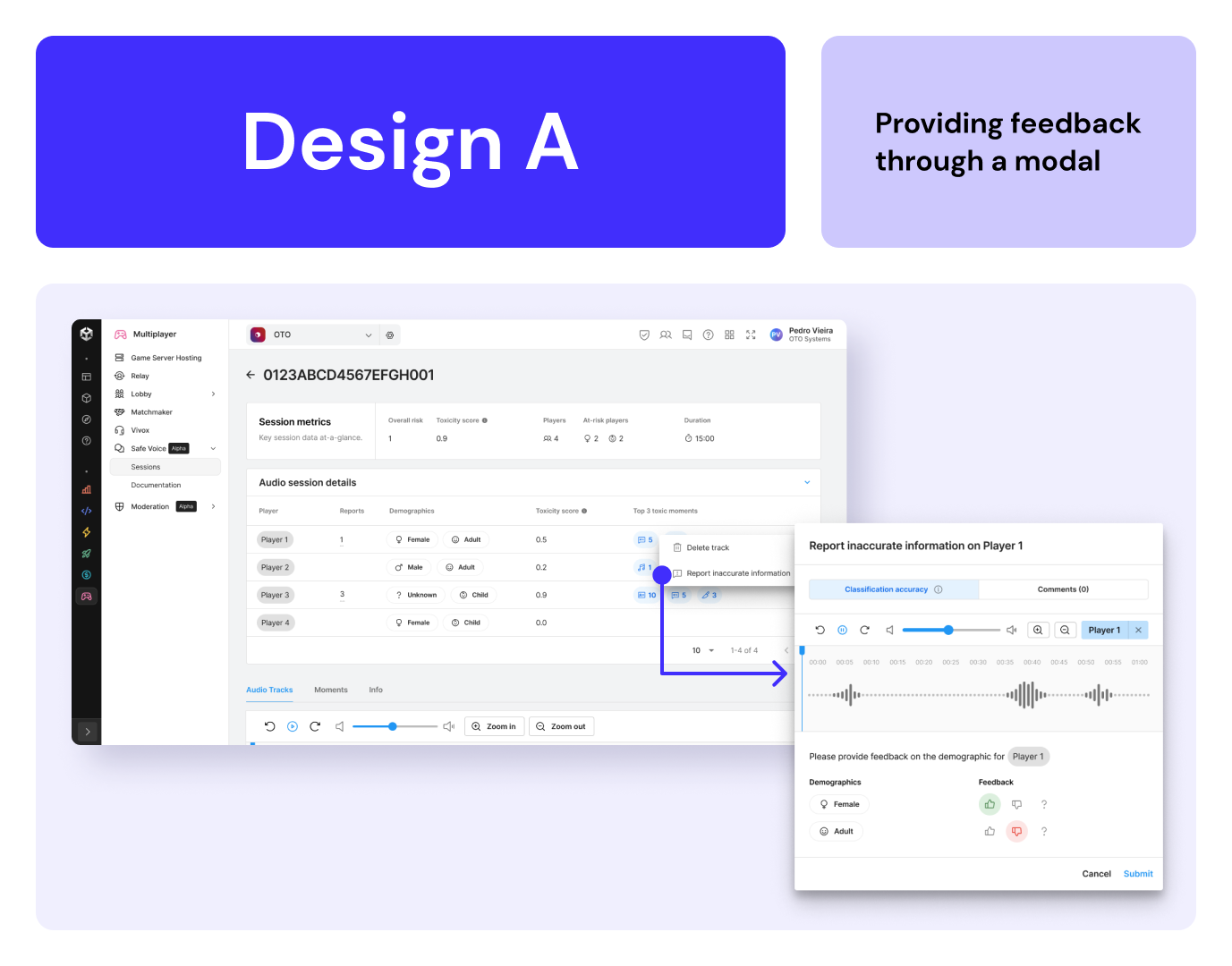

Screenshots of both flows used for A/B testing.
Alpha Launch
After the A/B test results, we launched the product with our first customer (Hi-Rez) incorporating design B. We also decided to wait and gather more insights from users before making any major changes to the current design layout.
The Results
- Analyzed 18K sessions and detected over 10K sessions with toxic moments in the first 45 days
- Enabled moderators to review 15-minute-long games with multiple players in under a minute
- Identified 2.8K sessions with audio disruptions, highlighting a previously unknown player experience issue
“Safe Voice gives me visibility into what’s happening in my game, not only from a trust and safety perspective, but also from a general gameplay perspective. I’m a big fan of the extra data points that we get in the Safe Voice dashboard. The tags help us understand what to look for when reviewing an incident.”
—Tony Jones, Lead Producer, Hi-Rez
Learnings and Reflections
Throughout this experience, I discovered that it's not because someone previously worked with designers necessarily comprehends the design process. When I joined the team, they already had existing designs, but the team was not aware that each change request required restarting the design process to ensure we addressed the right issues effectively.
Following the product launch, I organized a workshop session with my team to present the Design Process and how we collaborate with cross-functional teams. By the end of the session, my peers left with a clear understanding of the significance of the design process and why it is essential for successful outcomes.
On another note, striving to create responsible algorithms while challenging our biases was an invaluable aspect of this journey. I actively encouraged the team to consider gender as a multifaceted and diverse concept, avoiding reinforcing binary perspectives in the machine learning process. There is room for improvement, and I believe we can do better at inclusion by protecting all gender identities from toxicity.
© Naomi Fontaine — Product Designer
© Naomi Fontaine — Product Designer
© Naomi Fontaine — Product Designer
© Naomi Fontaine — Product Designer
© Naomi Fontaine — Product Designer